

Most AI writing is bad.
Not because AI is stupid. But because people talk to it the wrong way.
People type prompts like “write me a blog post about X.”
The result? Content so flat you’d swear it was pressed in a factory mold.
The truth is AI doesn’t “understand” your style. It doesn’t “get” your intentions. It only follows structure. And if you don’t give it a strong one, it builds its own.
That’s why most AI-written content feels generic, soulless, and instantly forgettable.
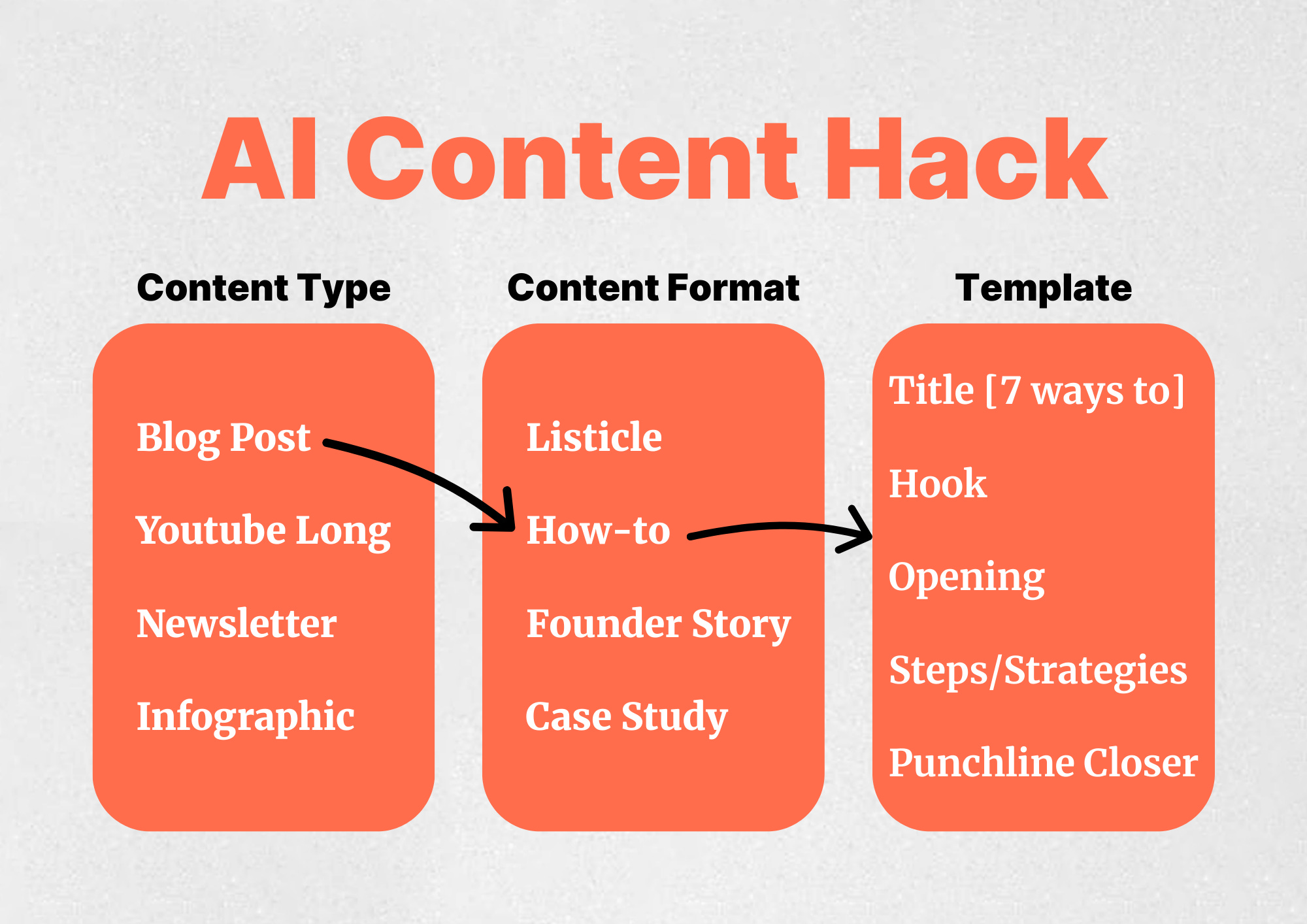
The fix is simple. You stop relying on vague prompts. You start building Content Templates.
Why Content Templates Work
A Content Template is the skeleton of a specific type of content. Not a script, not filler, but the exact frame that defines how a piece unfolds.
Think of it like blueprints for a cabinet. If you hand a carpenter nothing but the words “make me furniture,” you’ll get whatever they feel like building.
But if you hand them a detailed design-dimensions, shelves, compartments – the result is predictable, repeatable, and useful.
That’s what Content Templates do for AI. They lock the structure into place. They remove the guesswork. And when you control the frame, the words snap into form.
Step #1: Choose the Right Content Formats
Before you build, you decide what you’re building. That means picking the Content Formats that matter most for your brand.
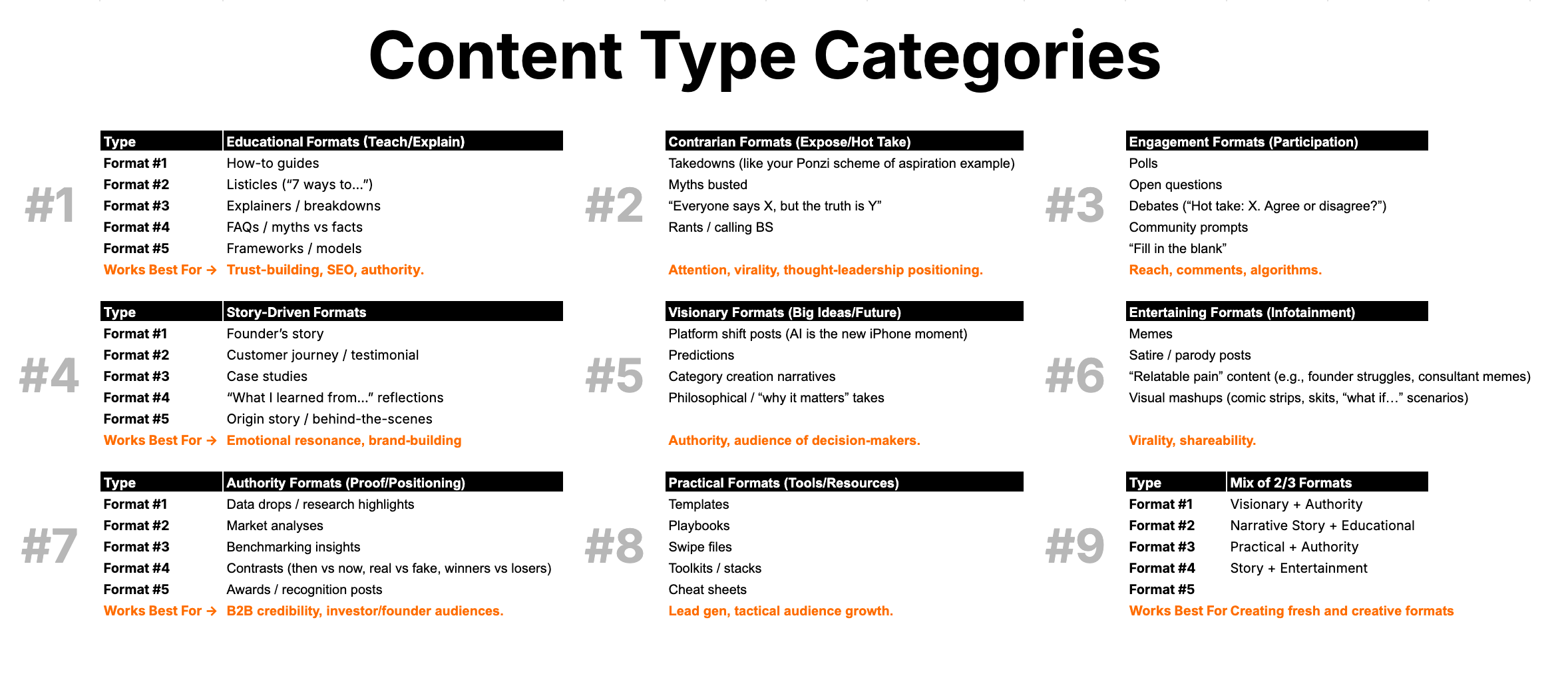
The strongest usually fall into three categories:
Educational → how-to guides, explainers, listicles
Practical → templates, checklists, cheat sheets
Authority → market analyses, comparisons, sharp contrasts
Pick two or three Content Formats. Forget the rest. Scatter kills, focus scales.
For example, a B2B SaaS company might commit to:
Educational guides that solve customer problems
Practical checklists that save teams time
Authority contrasts that show them ahead of competitors
Three formats → infinite angles.
Step #2: Study What Already Works
Don’t guess. Scout.
Look at content in your chosen Content Formats that has already gone viral. LinkedIn posts, Reddit threads, niche blogs, Substack essays. Which ones people couldn’t resist sharing? Which ones started conversations?
When you find them, take them apart.
How did they hook in the first line?
Where did they use questions or bullet points?
What was the key shift or moment of insight?
How did they close—with a call to action, or with an open thought?
You’ll start to see patterns. Those patterns are the hidden backbone of content that actually works.
Step #3: Turn Viral Posts Into Content Templates
This is where strategy becomes execution. You dissect a post until you can see its skeleton, then you turn that skeleton into a reusable template.
Here’s the exact analysis prompt I use when studying a LinkedIn post:
I will give you a LinkedIn post content. Analyze this LinkedIn Post:

- Tell me the exact structure of it from title to hook to the end.
- Break down its formats, spacing, where it uses bullet points, where it uses questions, where it lands the key insight.
- Analyze the copywriting style, and the rhythms and patterns of it.
- Give me a format I can use for myself later, exactly like this.
- Tell me what types of content are best suited for this format.
This pulls the architecture out of any viral post. And once you have the architecture, you can rebuild it for yourself.
Worked Example
Here’s a paraphrased LinkedIn post that went viral:
Title/Hook:
“In 2019, I was rejected from 32 job applications. In 2022, I hired 12 people.”Body:
First rejection → how it felt.
Continued rejections → hopelessness, self-doubt.
Small shift → learning how to position better.
First win → proof the strategy worked.
Fast forward → now hiring others.
Closing: “Rejection is not the end. Sometimes it’s just data for the next move.”
Run it through the analysis prompt, and the skeleton appears:
Hook: Contrast past pain with present success
Opening: Share a vulnerable moment
Rising tension: Multiple failures, increasing doubt
Turning point: One key shift or insight
Resolution: Proof of success
Close: Universal lesson for the reader
Short paragraphs. Simple language. Rhythm of tension and release. Perfect for career stories, founder lessons, or transformation narratives.
From Skeleton to Template
Now we weaponize it with the follow-up prompt:
Turn the structure above into a reusable prompt I can use every time to create similar posts.

- Include the exact structure as a template.
- Add examples inside the format where needed (hooks, bullet points, insights, closing lines).
- Make the prompt direct, so I can copy-paste it into AI and instantly generate new posts.
- Output the final result in a clean code box.
The result is a plug-and-play Content Template you can reuse. You start with someone else’s viral success. You end with your own scalable system.
The Payoff
Without Content Templates, AI writing is roulette. Each prompt is a spin of the wheel, and most spins land on noise.
With Content Templates, you control the frame. Every piece is sharper. Every result is more consistent. Scaling your brand voice stops being chaos and starts being engineering.
This isn’t a trick or a growth hack. It’s the method professionals use because it fixes the only problem that matters: structure.
The amateurs keep prompting.
The professionals build templates.
Which side are you going to choose?